
History
From the idea of a bathing company in 1896 to three islands joined by bridges. Five Bovallstrand residents founded the company in 1910; the stone bridge was finished in 1935 and opened by the Crown Prince. Here is the company’s own account, old leaflets, and the names and history of the islands.
History — about the company
A bathing company was first proposed in 1896, at the time when the great herring fishery was coming to an end. Its task would be to put up a bath house and otherwise promote the bathing-visitor trade. More tourists were to be drawn to Bovallstrand. The nearest warm bath house to the north was in Grebbestad, and to the south in Lysekil. In 1906 an attempt was made to form an association to build a smaller bath house. The plans were dropped because a number of difficulties arose and interest was slight. Local people argued that the price of food would rise if summer visitors came to the village. Those fears were probably justified to some extent, given the communications of the day. Farm produce arrived only by horse, when the farmers had time to drive down to Bovallstrand. There was only one district road to Bovallstrand, from Tossene.
The company is founded
Not until late 1908 was the project raised again (according to Alfred Larsson’s notes, in the late winter of 1909). It had earlier emerged that Alfred Karlsson was willing to sell his commercial property, where he ran a grocer’s shop. For the 1910 bathing season, AB Bovallstrands badinrättning was able to begin operations, described in the deed of foundation as: “to conduct bathing and hotel operations”. Seaweed baths, steam baths and mud baths were on offer. It was hard to persuade the people of Bovallstrand to subscribe for shares in the company. Not many in the village considered they could afford it. So in order to raise share capital, the five founders — Amandus Tillander, Frans O. Johansson, Johan Tobiasson, Fritz L. Karlsson and Alfred Larsson — had to look outside the village. Among others, they got brewery companies to subscribe. This laid the ground for the popularity Bovallstrand came to enjoy as a summer resort.
The bath house
165 shares made it possible, as a first step, to buy a commercial property by the shore. The price was 40,000 kronor. The building stood where the Badhotellet now stands. A warm bath house was fitted out in the outer part of the property. The equipment came from a closed-down warm bath house in the southern archipelago. The rest was leased to Mrs Romdahl and used as a hotel. At that time cold bathing was very unusual, and a society salon was a must. But the bathing company pointed out that the salinity of the sea water was 3.25 per cent and that there was “no obligation to society life, which many have commended”. Remarkably, the first bathing guest was a lady from the neighbouring village of Hunnebostrand. She paid 2 kronor a day. The “bath man” earned six kronor a week and the stoker 45 kronor a month. A tub bath cost 50 öre, a mud bath 75 öre, pine-needle and steam baths 90 öre, and a shower 10 öre. The first year’s profit came to 23.50 kronor. The hotel was later destroyed by fire and the Badhotellet was built on the same site. Today the Badhotellet has been converted into flats.
The business grows
In 1911 a bathing doctor and masseur were engaged in Bovallstrand. At the general meeting on 1 April 1913 it was decided to sell the old property with the hotel to A. Karlsson’s Brewery in Lysekil. Instead a plot was bought from Henrik Salberg, where a new warm bath house was to be built. The business continued until the 1960s. The building today serves as a workshop for Lars Högdén Service (Statoil).
Bathing resort day
After the First World War tourism increased. The people of Bovallstrand had realised that money could be made letting rooms to bathing guests. The income generally went into doing up the houses. But much was still lacking. People wanted beach bathing, a tennis court and a modern restaurant. Thanks to help from the younger members of Bovallstrand’s sports club (BIF), the Good Templars lodge and the bathing company, a joint effort produced “Bathing resort day” in 1929. The programme included a wrestling match between the European champion Cadier and Rydström, both from Borås, accordion playing and singing by Einar Fagstad, a film show, a flying display by Captain Ahrenberg, a rowing race and football. The turnout exceeded all expectations. So did the takings. 4,000 people each paid one krona to get in over the first two days. Gross income was 9,000 and the net 6,000. The money was divided equally between the associations. The surplus went, among other things, to the upkeep of Badholmen.
Badholmarna takes shape
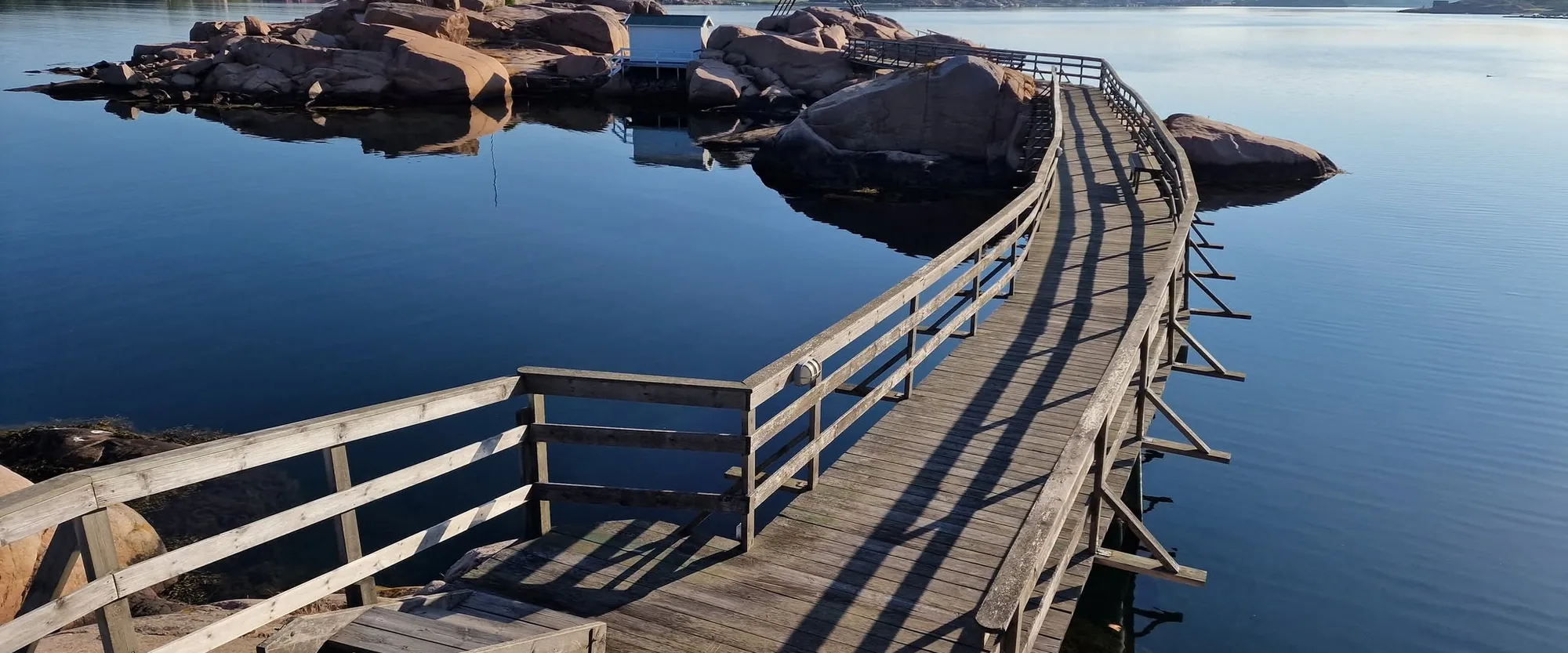
The following year it was time for the bathing company to make new investments. In 1930 the company was able to buy a 10-metre strip of shore at Henriksberg from Emanuel Henriksson, together with an island suitable for open-air bathing. Sörholmen (also known as Lilla Fiskholmen) was renamed Badholmen, and a timber bridge was built out to it. At the general meeting on 25 April 1932 it was decided to buy land from Ragnar Salberg in order to lay out the present tennis court. At the general meeting on 20 September 1933 it was decided that a stone bridge should be built to Badholmen, if a state grant could be obtained. Because of unemployment in the Sotenäset area, state and municipal support was granted in 1934 for building the stone bridge, which was completed in 1935 at a cost of 23,000 kronor against an estimated 9,000. The higher cost was due to difficult bottom conditions, with scrap fill down to a depth of 9 metres. At the fishermen’s request, an opening was left in the middle for small boats. They used to row that way in rough weather. Bathing huts, springboards and a diving tower were then built on Badholmen, and a swimming school was set up, run for many years by Agnes Högdén.
Finally Biskopsholmen and Mittholmen were bought in 1939 and joined to the others by a timber bridge. In 1935 Badholmarna was opened by the Crown Prince. His name is carved on Badholmen near the diving tower.
A stoker’s account
Gustaf Rundberg, who was a stoker in the summer of 1925, tells of his work:
I went to see Fritz Karlsson and learned that I was to start work as a stoker at the warm bath house. I met Karl-Johan, who showed me and taught me the work I was to do. It meant pumping water up into two large wooden vats, bought from Öckerö, and then filling a large copper set into a furnace. At six in the morning the firewood had to be brought out and the furnace lit. The water had to be hot so that the bath attendants Berta Niklasson and Gerda Rundberg could start drawing water and getting everything ready before the guests arrived. On some days there were as many as 40 baths, and then it was hard work keeping up with an old hand pump as all the tubs were filled. I positioned myself so that I could stand and read at the same time as I pumped.
Some evenings and Sundays I had to take the dinghy out to Hällsö and Tärneskären to gather seaweed for the seaweed baths, and out to Bergsvik to fetch clay or mud for the mud baths. The way it was done was to push a pipe with a hole in one side down through a thin layer of sand, and when you pulled it up you had a fine clay without a single grain of sand in it, soft as green soap. This mud was used by the bath attendants for what were called mud baths.
Sources:
BOVALLSTRAND — Ett kustsamhälles liv i ord och bild
Newspaper cuttings from Lysekilsposten.
Notes by Alfred Larsson
Old leaflets
Translated from the Swedish original of 1912.
Leaflet from 1912, E. F. Larsson’s printing house in Lysekil
Bovallstrand Bathing and Summer Resort
Is one of the loveliest fishing villages in Bohuslän, situated on the
Bottna fjord mentioned in the books of Emilie Flygare-Carlén, 2 hours by
steamer from Lysekil (daily service), 4 hours by steamer from Strömstad, 5
hours from Uddevalla and 7 hours from Gothenburg, with which places there is
direct steamer connection several times a week.
The nearest railway station is Dingle on the Bohus line, to which sta-
tion it is 27 km of good and even road (about 3 hours by carriage). On notice
by telephone here a carriage will meet you, or one may be had in Dingle.
Sanitary conditions are good and the state of health is very
good. Wholesome dwellings (most houses have a garden plot). Private rooms
may be had for 20–30 kr., and apartments of 3 rooms and kitchen for 100 kr. a
month, at lower prices for shorter periods. A suitable place for keeping one’s
own household.
Restaurant 2:25 per day.
A splendid view over the sea, with the lighthouse of the Väderöarna on the horizon.
A good supply of excellent boats for fishing and sailing. Sailing
boats may be hired by the month for 15–20 kr. For sailing with decked
boats …….. per hour. For longer periods and for larger parties by
arrangement. Sailing trips to the Väderöarna and Sotskär are recommended.
Among local sights, the old church at Svenneby is worth a visit, the mer-
chant houses in the archipelago, rock carvings, Hornborg castle (where exca-
vations have been made) and others.
Post arrives 6 times a week.
National telephone station.
The warm bath prices are:
Plain warm bath with shower ……….. Steam bath ……..
Mud bath . . . . . . . . . .. ………… Half bath ……..
All baths with 10 öre extra for bath linen.
Splendid beach bathing on a sandy bottom, for which a fee of 50
öre per week is charged.
Salinity of the water 3.25 per cent.
A doctor visits the place at least once a week.
A physiotherapist is available.
No obligation to society life, which many have commended.
Of every summer guest who stays more than a week an enrol-
ment fee of 1 kr. is required.
Enquiries are to be addressed to:
Bovallstrands Badinrättning, Bovallstrand
Stories
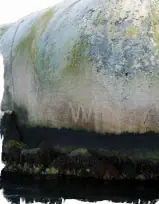
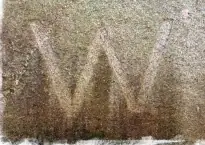
The story below is the reason for a carved W on Fiskholmen. The mark is on the rock face facing north-east, in towards the Bottnafjorden.
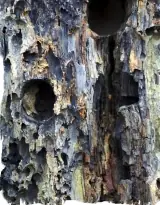
Pieces of wreckage from the ship have also been recovered.
The last voyage of the brig “Marie-Berthe”
The story has unfortunately had to be withdrawn. It will instead be published by its author in a book. More information will appear here when the book is finished.
The islands
On the map of 1840 the present Badholmarna were called Nordholmarne, Mettholmarne and Sörholmen. So they still were on the economic map of 1937. Sörholmen was also called Lilla Fiskholmen. Today they correspond to Biskopsholmen, also known as Fiskholmen (and as Stora Fiskholmen), together with Mittholmen and Badholmen. A noa name is a harmless name for a dangerous creature — “grey-legs” instead of wolf, for instance. Fiskholmen (“fish island”) is a noa name for Biskopsholmen (“bishop’s island”).
Priests bring bad luck when fishing. As you can read under Curiosities, anyone heading out to fish in the fjord should avoid passing through the sound nearest Biskopsholmen.
Sources:
BOVALLSTRAND — Ett kustsamhälles liv i ord och bild
Newspaper cuttings from Lysekilsposten.